Lalibela in November: Millennia-Old Faith and Travelling in Turbulent Times
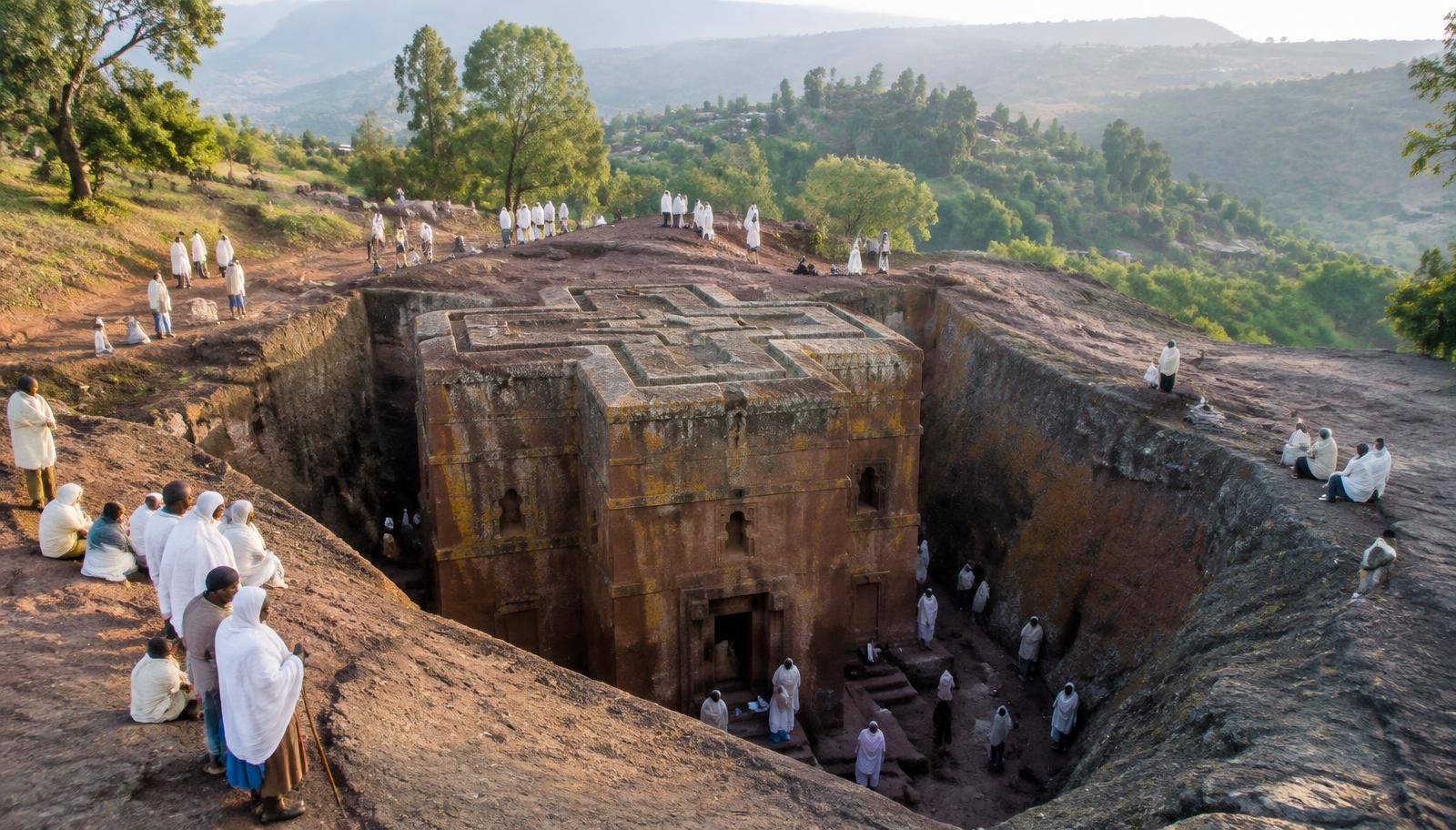
It is shortly after sunrise when the first chants rise from the depths. Hundreds of believers in white cotton shawls stand at the edge of the rock pits, some of them since the night before. Below them lies Bete Giyorgis, the Church of Saint George – not a building in the usual sense, but a cross carved from top to bottom into the red volcanic rock some 800 years ago.
A living Jerusalem in the highlands
Lalibela, at around 2,500 metres in the Ethiopian highlands, is one of the holiest places of the Ethiopian Orthodox Tewahedo Church. According to tradition, the eleven rock churches were created under King Lalibela in the 12th and 13th centuries – as a “new Jerusalem” for pilgrims whose way to the Holy Land was blocked. They have been a UNESCO World Heritage Site since 1978.
Yet Lalibela is no museum. The Ethiopian church is one of the oldest Christian churches in the world; its roots go back to the 4th century. Priests still read here in Ge'ez, the ancient liturgical language. Fasting days, processions, drums and sistra set the rhythm of the town – a tradition passed on almost unbroken for centuries.
Why November
After the long rainy season, the highlands are still green in November, the air is clear and the nights are cool. It is a quiet time before the great feasts such as Genna (Christmas) and Timkat (Epiphany) – with the advantage of experiencing Lalibela not in the crowds but in the everyday life of the community: early services, silent prayers in the rock passages, encounters with priests and deacons.
The honest side: travelling in a troubled region
Anyone who wants to travel to Lalibela today has to know the reality. The Amhara region has for some time been marked by armed conflict and a tense security situation. Roads can be closed at short notice, the situation sometimes changes from day to day, and official travel advice warns against travel to parts of the region.
You don't undertake a journey like this on your own or from a catalogue. You undertake it with people who know the country – and whom the country trusts.
That is exactly where the difference lies. Contacts built up over years – local guides, drivers, hosts and community representatives – give us assessments of the situation that no news site can offer. We plan with alternatives, prefer domestic flights to long overland routes, keep the group small and stay flexible until the last moment. If the situation is not justifiable, we re-plan or cancel – safety always comes first, without exception.
The 7 Seas approach
We travel in a group of 6 to 10 people, with respect for the faith and the people who live here. No sensationalism, no crisis tourism – but genuine interest and a willingness to listen. Before the trip we talk in detail about risks, behaviour on site and shared limits. Those who embrace this will experience a place that is among the most impressive testimonies of living faith on our planet.
Ready for your own adventure?
Tell us where you want to go – we'll get back to you personally.
Send a no-obligation inquiry